3.1
Unlocking the Secrets of Genes
You might think the study of genetics is solely a matter of biology. Although it's true that biologists are keenly interested in understanding how information gets passed from one generation to the next at a cellular level, psychologists also want to know how genetic information influences what we think, how we feel, and how we act.
The Human Genome
Researchers in behavioral genetics attempt to tease apart the relative contributions of heredity and environment to explain individual differences across people by adopting a nature and nurture approach in their investigations. Hereditary contributions originate in genetics, so let's begin by looking at what genes are and how they operate.
Genes, the basic units of heredity, are located on chromosomes, rod-shaped structures found in the center (nucleus) of every cell of the body. Each sperm cell and each egg cell (ovum) contains 23 chromosomes, so when a sperm and egg unite at conception, the fertilized egg and all the body cells that eventually develop from it (except for sperm cells and ova) contain 46 chromosomes, arranged in 23 pairs.
Chromosomes consist of threadlike strands of DNA (deoxyribonucleic acid) molecules, and genes consist of small segments of this DNA (see Figure3.1). Each human chromosome contains thousands of genes. However, 98.8 percent of our total DNA, called noncoding DNA, lies outside the genes. This DNA used to be called “junk DNA” because scientists believed it was not important, but this belief is changing fast. Changes in this noncoding DNA may be associated with common diseases. Messages from noncoding DNA, along with random chemical events in cells, may also affect the expression of certain genes.
Figure3.1
Genes and Chromosomes
All of our genes, together with noncoding DNA, make up the human genome. Most genes in the human genome are found in other animals as well, but some are unique to our species, setting us apart from chimpanzees, mice, and wasps. Many genes contribute directly to a particular trait, but others work indirectly by switching other genes on or off. Many genes are inherited in the same form by everyone; others vary, contributing to our individuality.
Within each gene are four bases, the chemical elements that form DNA: adenine, thymine, cytosine, and guanine. These bases are identified by the letters A, T, C, and G and are arranged in a certain sequence, such as ACGTCTCTATA. In 1953, James Watson and Francis Crick made a groundbreaking discovery, which they published in a 985-word paper that revolutionized the field of genetics. They determined that DNA is always made up of two strands, with the bases in the middle holding the strands together in pairs—the famous double helix—as you can see in Figure3.2.
Figure 3.2
DNA Double Helix
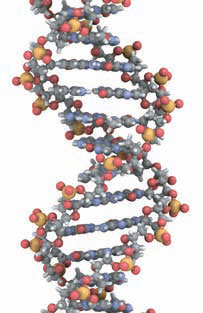
A “helix” is an object with a three-dimensional twisting shape that looks like a wire wrapped around a cylinder. Crick and Watson’s famous discovery was that DNA is always made up of two helixes, with the strands held together by four chemical elements called bases.
Within a gene, a particular sequence may contain thousands or even millions of bases, which together constitute a code for the synthesis of one of the many proteins that affect virtually every aspect of the body, from its structure to the chemicals that keep it running. But this is a simplification; one small variation in the code can create a qualitatively different kind of protein. Also, many genes can make more than one protein, depending on when and where different segments of DNA on the gene are activated. In fact, our 22,000 or so genes can produce hundreds of thousands of different proteins. You might think that 22,000 is a lot of genes, but that's only about twice as many as a fruit fly has—and corn has about 32,000 (Schnable et al., 2009). The key is not how many genes you have, but what those genes can do.
In 2006, an international collaboration of 2,000 researchers working on the Human Genome Project announced that it had finished mapping the entire human genome. They had identified the sequence of nearly all 3 billion bases (those As, Cs, Ts, and Gs) and determined how the genes are arranged on the chromosomes. Lately, scientists have also begun using computers and new technologies to examine as many as a million DNA differences at once. Then they compare these DNA differences in people who share a particular disease or trait with those of people who do not have it. In these studies, called genome-wide association studies, researchers may have a candidate “culprit” gene in mind, but they do not need to do so because the approach is entirely statistical, based on correlations. The points where sequences differ in the two groups of people give researchers a clue to which sequences might be associated with a specific disease or trait (Hardy & Singleton, 2009). The latest big new development is whole-genome sequencing, sequencing the entire 3 billion base pairs of DNA (Plomin, 2012; Plomin, DeFries, & Knopik, 2013).
Scientists also sometimes use an older technique to carry out linkage studies, searching for the genes associated with rare disorders. Linkage studies take advantage of the tendency of genes lying close together on a chromosome to be inherited together across generations. The researchers start out by looking for DNA differences called genetic markers, DNA segments that vary considerably among individuals and whose locations on the chromosomes are already known. They then look for patterns of inheritance of these markers in large families in which a condition—say, depression or impulsive violence—is common. If a marker tends to exist only in family members who have the condition, then it can be used as a genetic landmark. The gene involved in the condition is apt to be located nearby on the chromosome, so the researchers have some idea where to search for it.

Ask members of your family, one person at a time, to clasp their hands together. Include aunts and uncles, grandparents, and as many other biological relatives as possible. Which thumb does each person put on top? The tendency to fold the left thumb over the right one or vice versa tends to run in families, and is thought by many geneticists to be influenced by genes. Do your relatives show one tendency over the other? (If your family is an adoptive one, of course, you have less chance of finding a trend.) Try the same exercise with someone else’s family; do you get the same results? Even for behavior as simple as thumb-folding, the details of how genes might exert their effect remain uncertain.
But even when researchers locate a gene, they do not automatically know its role in physical or psychological functioning. Usually, locating a gene is just the first small step in understanding exactly what it does and how it works. Be wary of media reports implying that some gene (or a mutation) is the only one involved in a complex psychological ability or trait, such as intelligence or shyness, or a disorder, such as autism. It seems that nearly every year brings another report about some gene that supposedly explains a human trait. A few years back, newspapers even announced the discovery of a “worry gene.” Don't worry about it! Most human traits, even such seemingly straightforward ones as height and eye color, are influenced by more than one gene. Psychological traits are especially likely to depend on multiple genes—dozens of them, or even hundreds—with each one accounting for just a tiny part of the variance among people. Conversely, any single gene is apt to influence many different behaviors. The moral: All announcements in the media of a “gene for this” or a “gene for that” should be viewed with extreme caution. Watch Genetic Mechanisms and Behavioral Genetics 1 for more information about genes and chromosomes.
Watch
Genetic Mechanisms and Behavioral Genetics 1
Epigenetics
Many people think of the genome as a static blueprint, a set of coded messages that never changes over a person's lifetime. But this is a big misconception. One reason has to do with mutations, which produce variant forms of genes; these mutations may alter just one DNA base or, at the other extreme, a large part of a chromosome. Many mutations (gene variants) are inherited from our parents, but others are new ones that arise before or after birth. Mutations may occur because of a mistake made when DNA copies itself during cell division. Some occur because of environmental factors, such as ultraviolet radiation from the sun, which can cause mutations that lead to skin cancer.
Thus people differ in part because they carry different mutations in their genetic code. But they also differ for another reason: Scientists are learning that stable changes in gene (and therefore trait) expression can occur for a variety of reasons, without any changes in the sequence of bases in a gene's DNA. One of the most exciting developments in genetics is a specialty called epigenetics, which studies such changes (Berger et al., 2009). The mechanisms involve chemical molecules that regulate the activity of the genes. These changes are like software that tells your genome hardware to become active or inactive. Epigenetic changes affect behavior, learning and memory, and vulnerability to mental disorders (Zhang & Meaney, 2010). The video Epigenetics will tell you more about this fascinating area of investigation.
Watch
Epigenetics
Epigenetic changes may help explain why one identical twin might get a disease and the other not get it. They can also help explain why identical twins and even cloned, genetically identical animals living in exactly the same environment may differ considerably in appearance and behavior (Raser & O'Shea, 2005). Yes, you read that right: Even clones can differ. The study of epigenetics is demonstrating that the timing and pattern of genetic activity are critical not only before birth but also throughout life (Feinberg, 2008). And just like mutations, epigenetic changes can be affected by environmental factors (Plomin et al., 2013; Zhang & Meaney, 2010). In coming years, you will be hearing a lot more about epigenetics, and how your own habits, activities, drug use, and stress level might affect the activity of your genes.
Scientists are understandably excited about these advances, but, as usual, we should be wary of oversimplification. Some popular writers get carried away. A news headline taken from a preliminary study suggesting that childhood poverty affects adult genetics blared: “Babies born into poverty are damaged forever before birth!” (reported in Davey Smith, 2012; Heijmans & Mill, 2012). For their part, some scientists believe that the ability to scan a person's unique genome will soon permit “personalized medicine,” where your particular genetic pattern will determine the treatment you need for a given disease. Yet caution is called for here, too. Epidemiologist George Davey Smith (2011) explained how the hope for personalized medicine overlooks the powerful role of randomness and chance in human disease, and he calls epigenetic explanations “the currently fashionable response to any question to which you do not know the answer.” Epigenetics and genetic testing will undoubtedly provide some fascinating discoveries about human behavior and health, but they will never provide the whole story—as we discuss further in “Taking Psychology with You” at the end of this chapter.