11.4
Stress and Emotion
Perhaps you have heard people say things like “She was so depressed, it's no wonder she got sick” or “He's always so angry, he's going to give himself a heart attack one day.” Are negative emotions, especially anger and depression, hazardous to your health?
First, we can eliminate the popular belief in a “cancer-prone” personality. (This notion was initially promoted by the tobacco industry to draw attention away from smoking as a leading cause of cancer.) Research has thoroughly discredited this belief; studies of thousands of people around the world, from Japan to Finland, have found no link between personality traits and risk of cancer (Nakaya et al., 2003).
Second, we need to separate the effects of negative emotions on healthy people from the effects of such emotions on people who are ill. After a person already has a virus or medical condition or is living in a chronically stressful situation, negative emotions such as anxiety and helplessness can indeed increase the risk of illness and affect the speed of recovery (Kiecolt-Glaser et al., 1998). People who become depressed after a heart attack are significantly more likely to die from cardiac causes in the succeeding year, even controlling for severity of the disease and other risk factors (Frasure-Smith et al., 1999). But can anger and depression be causes of illness on their own? Some answers are provided in the video Stress Effects.
Watch
Stress Effects
Hostility and Depression: Do They Hurt?
One of the first modern efforts to link emotions and illness occurred in the 1970s, with research on the “Type A” personality, a set of qualities thought to be associated with heart disease: ambitiousness, impatience, anger, working hard, and having high standards for oneself. Later studies ruled out all of these factors except one: The toxic ingredient in the Type A personality turned out to be hostility (Myrtek, 2007). Indeed, working hard and having high standards proved to be important factors in good health and longevity, as the Termite study showed (Friedman & Martin, 2011).
By “hostility,” we do not mean the irritability or anger that everyone feels on occasion, but cynical or antagonistic hostility, which characterizes people who are mistrustful of others and always ready to provoke mean, furious arguments. In a classic study of male physicians who had been interviewed as medical students 25 years earlier, those who were chronically angry and resentful were five times as likely as nonhostile men to get heart disease, even when other risk factors such as smoking and a poor diet were taken into account (Ewart & Kolodner, 1994; Williams, Barefoot, & Shekelle, 1985) (see Figure11.5). These findings have been replicated in other large-scale studies, with African Americans and whites, and with women as well as men (Krantz et al., 2006; Williams et al., 2000). Proneness to anger is a significant risk factor all on its own for impairments of the immune system, elevated blood pressure, heart disease, and even slower healing of wounds (Chida & Hamer, 2008; Gouin et al., 2008; Suinn, 2001).
Figure 11.5
Hostility and Heart Disease
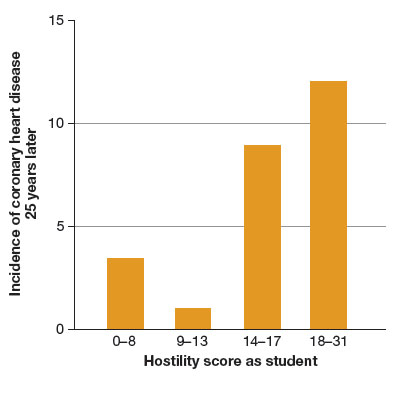
Anger is more hazardous to health than a heavy workload. Men who had the highest hostility scores as young medical students were the most likely to have coronary heart disease 25 years later (Williams, Barefoot, & Shekelle, 1985).
Clinical depression, too, is linked to at least a doubled risk of later heart attack and cardiovascular disease (Frasure-Smith & Lespérance, 2005; Gan et al., 2014). But what accounts for that link? A large prospective study found that depressed people were more likely to accumulate fat in the belly and midriff (perhaps because of the elevated cortisol that often occurs with depression), where it is more likely to increase the risk of diabetes and heart disease (Vogelzangs et al., 2008). Thus, one reason that depression might lead to heart disease over time would not be depression itself, but more likely the lethargy and overeating that depression can produce in some of its sufferers.
For some time, researchers thought that depression might also lead to cancer, but now it looks as though the reverse is true—that cancer can cause depression, and not just because the diagnosis is “depressing.” Cancerous tumors, as well as the immune system that is fighting them, produce high levels of a chemical that can cause the emotional and behavioral symptoms of depression (Brüning et al., 2015). A study of cancer in rats, which after all are not aware of having the disease, found that the animals would float passively in water instead of swimming for safety, and show other signs of anxiety and apathy (Pyter et al., 2009).
Positive Emotions: Do They Help?
Just as negative emotions can be unhealthful, positive emotions seem to be healthful, although it is difficult to separate cause and effect. Finding a group of very old people who are happy does not mean that happiness contributed to their longevity; as people age, they often become less angry and more content. They might have been really surly when they were age 20 or 50. Moreover, cheerfulness and health may coexist without one causing the other. A longitudinal study of Harvard men found that some life paths led the men to be happy and well and others to be sad and ill. Happiness did not cause wellness, and sadness did not cause illness (Vaillant, 2012).
Nonetheless, positive emotions could be physically beneficial because they soften or counteract the high arousal caused by negative emotions or chronic stressors. They may dispose people to think more creatively about their opportunities and choices and, as with optimism and internal locus of control, motivate people to take action to achieve their goals (Kok, Catalino, & Frederickson, 2008). People who express positive feelings are also more likely to attract friends and supporters than are people who are always bitter and brooding, and, as we will see, social support is one of the most powerful contributors to good health (Friedman & Martin, 2011; Ong, 2010; Pressman & Cohen, 2012).
If you don't feel bouncy and happy all the time, don't worry; everyone feels grumpy, irritable, and unhappy on occasion. But are negative emotions more typical of your life than positive ones? If so, what actions might you take to ensure a better ratio of positive to negative emotions? A pioneering researcher in the field of health psychology discusses some of these issues in the video Personality and Health.
Watch
Personality and Health
Emotional Inhibition and Expression
If negative emotions are risky, you might assume that the safest thing to do when you feel angry, depressed, or worried is to try to suppress those feelings. For small problems and annoyances, suppression is usually just fine! But anyone who has tried to banish an unwelcome thought, a bitter memory, or pangs of longing for an ex-lover knows how hard it can be to do this (Wegner, 1994). When you are trying to avoid a thought, you are in fact processing the thought more frequently; you are rehearsing it. That is why, when you are obsessed with someone you were previously romantically involved with, trying not to think of the person actually prolongs your emotional responsiveness to him or her (Wegner & Gold, 1995).
The continued inhibition of thoughts and emotions actually requires physical effort that can be stressful to the body. People who are able to express matters of great emotional importance to them show elevated levels of disease-fighting white blood cells, whereas people who suppress such feelings tend to have decreased levels (Smyth, Pennebaker, & Arigo, 2012). Suppressing important feelings has a social cost, too. In a longitudinal study that followed first-year college students as they adjusted to being in a new environment, those who expressed their worries and fears openly with other students ended up with better relationships and greater satisfaction, compared to those who said they preferred to keep their emotions to themselves (Srivastava et al., 2009).

Everyone has secrets and private moments of sad reflection. But when you feel sad or fearful for too long, keeping your feelings to yourself may increase your stress.
The Benefits of Confession Given the findings on the harmful effects of feeling negative emotions and also the difficulty and costs of suppressing them, what is a person supposed to do with them? One way to reduce the wear and tear of negative emotions comes from research on the benefits of confession: divulging (even if only to yourself) private thoughts and feelings that make you ashamed, worried, frightened, or sad (Pennebaker, 2002, 2011). A randomized controlled trial of 156 patients following their first heart attack found that those who wrote about their feelings about the heart attack fared better and improved more quickly than a control group who wrote about neutral daily activities (Willmott et al., 2011). And first-year college students who privately wrote down their “deepest thoughts and feelings” about coming to college reported greater short-term homesickness and anxiety, compared to students who wrote about trivial topics. But by the end of the school year, they had had fewer bouts of flu and fewer visits to the infirmary than the control group did (Pennebaker, Colder, & Sharp, 1990).
This method is especially powerful when people write about traumatic experiences. When a group of college students was asked to write about a personal, traumatic experience for 20 minutes a day for 4 days, many told stories of sexual coercion, physical beatings, humiliation, or parental abandonment. Yet most had never discussed these experiences with anyone. The researchers collected data on the students' physical symptoms, white blood cell counts, emotions, and visits to the health center. On every measure, the students who wrote about traumatic experiences were better off than those who wrote only about neutral topics (Pennebaker, Kiecolt-Glaser, & Glaser, 1988). Subsequent research has confirmed the benefits of expressing and working through memories of traumatic events head on, rather than trying to suppress intrusive, troubling thoughts (Dalgliesh, Hauer, & Kuyken, 2008).
The benefits of writing occur primarily when the revelation produces insight and understanding, thereby fostering the ability to distance yourself from the bad experience and ending the stressful repetition of obsessive thoughts and unresolved feelings (Kross & Ayduk, 2011; Lepore, Ragan, & Jones, 2000). One young woman, who had been molested at the age of 9 by a boy a year older, at first wrote about her feelings of embarrassment and guilt. By the third day, she was writing about how angry she felt at the boy. By the last day, she had begun to see the whole event differently; he was a child too, after all. When the study was over, she said, “Before, when I thought about it, I'd lie to myself. . . . Now, I don't feel like I even have to think about it because I got it off my chest. I finally admitted that it happened.”
The Benefits of Letting Grievances Go Another way of letting go of negative emotions is to give up the thoughts that produce them and adopt a perspective that might lead to forgiveness. When people rehearse their grievances and hold on to their grudges, their blood pressure, heart rate, and skin conductance rise. Forgiving thoughts (as in the preceding example—“He was a child too”) reduce these signs of physiological arousal and restore feelings of control (Witvliet et al., 2015). (See Figure11.6.) Forgiveness, like confession when it works, helps people see events in a new light. It promotes empathy, the ability to see the situation from another person's perspective. It strengthens and repairs ongoing relationships (Fehr, Gelfand, & Nag, 2010). But it is important not to oversimplify: Forgiveness is not a cure-all and not always a good thing; it depends on the context in which the conflict occurs (McNulty & Fincham, 2012). In a study of women at a domestic violence shelter, the women who forgave their abusive partners were more likely to return to them, and within marriage, forgiveness predicts continued psychological and physical violence (McNulty, 2011).
Figure 11.6
Some Benefits of Heartfelt Forgiveness

Participants in a study were asked to think of someone who they felt had offended or hurt them. Then they were asked to imagine unforgiving reactions (such as rehearsing the hurt and harboring a grudge) and forgiving reactions (such as feeling empathy or forgiving the person). As you can see from the orange bars, people’s heart rates increased much more sharply when their thoughts were unforgiving. The blue bars indicate the heart rates also took longer to return to normal in the unforgiving conditions.
[[For Revel: Insert Interactive 11.9]]
Forgiveness does not mean that the offended person denies, ignores, or excuses the offense, which might be serious. It does mean that the victim is able, finally, to come to terms with the injustice and let go of obsessive feelings of hurt, rage, and vengefulness. As the Chinese proverb says, “He who pursues revenge should dig two graves.”