14.1
Psychodynamic Theories of Personality
A man apologizes for “displacing” his frustrations at work onto his family. A woman suspects that she is “repressing” a childhood trauma. An alcoholic reveals that he is no longer “in denial” about his drinking. A teacher informs a divorcing couple that their 8-year-old child is “regressing” to immature behavior. All these notions about displacing, repressing, denying, and regressing have become commonplace in everyday language, but their usage in this context can be traced back to Sigmund Freud's views on personality.
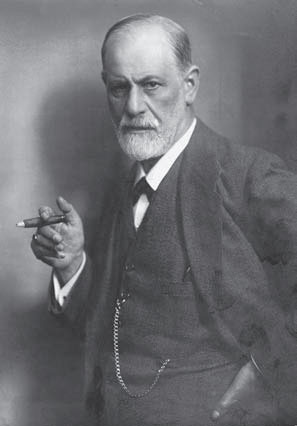
Sigmund Freud (1856-1939).
Freud and Psychoanalysis
Like most of the theorists and researchers we'll discuss in this chapter, Freud viewed personality as a distinctive pattern of behavior, mannerisms, thoughts, motives, and emotions that characterize an individual over time and across situations. But to enter the world of Sigmund Freud is to enter a realm of unconscious motives, raging passions, guilty secrets, unspeakable yearnings, and conflicts between desire and duty. These unseen forces, Freud believed, have far more power over our personalities than our conscious intentions do. Freud's theory of psychoanalysis highlighted the role of these motives and conflicts in shaping personality.
Freud's theory is called psychodynamic because it emphasizes the movement of psychological energy within the person. (Freud did not use “dynamic” in today's sense, to mean “powerful” or “energetic.” Dynamics is a term from physics that refers to the motion and balance of systems under the action of outside or internal forces.) Today's psychodynamic theories differ from Freudian theory and from one another, but they all share an emphasis on unconscious processes going on within the mind. They also share an assumption that adult personality and ongoing problems are formed primarily by experiences in early childhood. These experiences produce unconscious thoughts and feelings, which later form characteristic habits, conflicts, and often self-defeating behavior.
The Structure of Personality In Freud's theory, personality consists of three major systems: the id, the ego, and the superego. Any action we take or problem we have results from the interaction and degree of balance among these systems (Freud, 1905b, 1920/1960, 1923/1962).
The id, which is present at birth, is the reservoir of unconscious psychological energies and the motives to avoid pain and obtain pleasure. The id contains two competing instincts: the life, or sexual, instinct (fueled by psychic energy called the libido) and the death, or aggressive, instinct. As energy builds up in the id, tension results. The id may discharge this tension in the form of reflex actions, physical symptoms, or uncensored mental images and unbidden thoughts.
The ego, the second system to emerge, is a referee between the needs of instinct and the demands of society. It bows to the realities of life, putting a rein on the id's desire for sex and aggression until a suitable, socially appropriate outlet for them can be found. The ego, said Freud, is both conscious and unconscious, and it represents “reason and good sense.”
The superego, the last system of personality to develop, is the voice of conscience, representing morality and parental authority. The superego judges the activities of the id, handing out good feelings of pride and satisfaction when you do something well and handing out miserable feelings of guilt and shame when you break the rules. The superego is partly conscious but largely unconscious.
According to Freud, the healthy personality must keep all three systems in balance. Someone who is too controlled by the id is governed by impulse and selfish desires. Someone who is too controlled by the superego is rigid, moralistic, and bossy. Someone who has a weak ego is unable to balance personal needs and wishes with social duties and realistic limitations.
Defense Mechanisms If a person feels anxious or threatened when the wishes of the id conflict with social rules, the ego has weapons at its command to relieve the tension. These unconscious strategies, called defense mechanisms, deny or distort reality, but they also protect us from conflict and anxiety. They become unhealthy only when they cause self-defeating behavior and emotional problems. Here are five primary defense mechanisms identified by Freud and later analysts (A. Freud, 1967; Perry & Metzger, 2014; Vaillant, 1992):
Repression occurs when a threatening idea, memory, or emotion is blocked from consciousness. A woman who had a frightening childhood experience that she cannot remember is said to be repressing her memory of it. Freud used the term repression to mean both unconscious expulsion of disturbing material from awareness and conscious suppression of such material. However, modern analysts tend to think of it only as an unconscious defense mechanism.
Projection occurs when a person's own unacceptable or threatening feelings are repressed and then attributed to someone else. A person who is embarrassed about having sexual feelings toward members of a different ethnic group may project this discomfort onto them, saying, “Those people are dirty-minded and oversexed.”
Displacement occurs when people direct emotions that make them uncomfortable or conflicted—commonly, anger and lust—toward people, animals, or objects that are not the real object of their feelings. A boy who is forbidden to express anger toward his father may “take it out” on his toys or his younger sister. When displacement serves a higher cultural or socially useful purpose, as in the creation of art or inventions, it is called sublimation. Freud argued that society has a duty to help people sublimate their unacceptable sexual and aggressive impulses for the sake of civilization. Sexual passion may be sublimated into the creation of art or literature, and aggressive energy into sports.
Regression occurs when a person reverts to a previous phase of psychological development. An 8-year-old boy who is anxious about his parents' divorce may regress to earlier habits of thumb sucking or clinging. Adults may regress to immature behavior when they are under pressure—perhaps by having temper tantrums when they don't get their way.
Denial occurs when people refuse to admit that something unpleasant is happening, such as mistreatment by a partner; that they have a problem, such as drinking too much; or that they are feeling a forbidden emotion, such as anger. Denial protects a person's self-image and preserves the illusion of invulnerability: “It can't happen to me.”
Defense Mechanisms
The Development of Personality Freud argued that personality develops in a series of psychosexual stages, in which sexual energy takes different forms as the child matures. Each new stage produces a certain amount of frustration, conflict, and anxiety. If these are not resolved properly, normal development may be interrupted, and the child may remain fixated, or stuck, at the current stage.
Freud thought that some people remain fixated at the oral stage, which occurs during the first year of life, when babies experience the world through their mouths. As adults, they will seek oral gratification in smoking, overeating, nail-biting, or pencil-chewing; some may become clinging and dependent, like a nursing child. Others remain fixated at the anal stage, at ages 2 to 3, when toilet training and control of bodily wastes are the key issues. They may become “anal retentive,” holding everything in, obsessive about neatness and cleanliness. Or they may become just the opposite, “anal expulsive”—messy and disorganized.
For Freud, however, the most crucial stage for the formation of personality was the phallic (Oedipal) stage, which lasts roughly from age 3 to age 5 or 6. During this stage, said Freud, the child unconsciously wishes to possess the parent of the other sex and to get rid of the parent of the same sex. Children often proudly announce, “I'm going to marry Daddy (or Mommy) when I grow up,” and they reject the same-sex “rival.” Freud labeled this phenomenon the Oedipus complex, after the Greek legend of King Oedipus, who unwittingly killed his father and married his mother.
Boys and girls, Freud believed, go through the Oedipal stage differently. Boys are discovering the pleasure and pride of having a penis, so when they see a naked girl for the first time, they are horrified. Their unconscious exclaims (in effect), “Her penis has been cut off! Who could have done such a thing to her? Why, it must have been her father. And if he could do it to her, my father could do it to me!” This realization, said Freud, causes the boy to repress his desire for his mother and identify with his father. He accepts his father's authority and the father's standards of conscience and morality; the superego has emerged.
Freud admitted that he did not quite know what to make of girls, who, lacking the penis, could not go through the same steps. He speculated that a girl, upon discovering male anatomy, would panic that she had only a puny clitoris instead of a stately penis. She would conclude that she already had lost her penis. As a result, Freud said, girls do not have the motivating fear that boys do to give up their Oedipal feelings and develop a strong superego; they have only a lingering sense of “penis envy.”
Freud believed that when the Oedipus complex is resolved, at about age 5 or 6, the child's personality is fundamentally formed. Unconscious conflicts with parents, unresolved fixations and guilts, and attitudes toward the same and the other sex will continue to replay themselves throughout life. The child settles into a supposedly nonsexual latencystage, in preparation for the genital stage, which begins at puberty and leads to adult sexuality.
In Freud's view, therefore, your adult personality is shaped by how you progressed through the early psychosexual stages, which defense mechanisms you developed to reduce anxiety, and whether your ego is strong enough to balance the conflict between the id (what you would like to do) and the superego (your conscience).
Psychosexual Stages of Personality Development
Freud in Perspective As you might imagine, Freud's ideas were not exactly received with yawns. Sexual feelings in 5-year-olds! Repressed longings in respectable adults! Unconscious meanings in dreams! Penis envy! This was strong stuff in the early years of the 20th century, and before long, psychoanalysis had captured the public imagination in Europe and the United States.
But psychoanalysis also produced a sharp rift with the emerging schools of empirical psychology because so many of Freud's ideas were scientifically untestable or failed to be supported when they were tested. Modern critics have discovered that Freud was not the theoretical genius, impartial scientist, or even successful clinician that he claimed to be. On the contrary, Freud often bullied his patients into accepting his explanations of their symptoms and, the greatest sin for anyone claiming to be a scientist, he ignored all evidence disconfirming his ideas (Borch-Jacobsen & Shamdasani, 2012; McNally, 2003; Powell & Boer, 1995; Samuel, 2013; Webster, 1995).
On the positive side, Freud welcomed women into the profession of psychoanalysis, wrote eloquently about the devastating results for women of society's suppression of their sexuality, and argued, ahead of his time, that homosexuality was neither a sin nor a perversion but a “variation of the sexual function” and “nothing to be ashamed of” (Freud, 1961). Freud was thus a mixture of intellectual vision and blindness, sensitivity and arrogance. His provocative ideas left a controversial legacy to psychology, one that others began to tinker with immediately.
Other Psychodynamic Approaches
Some of Freud's followers stayed in the psychoanalytic tradition and modified Freud's theories from within. Women, as you might imagine, were not too pleased about “penis envy.” Clara Thompson (1943/1973) and Karen Horney [HORN-eye] (1926/1973) argued that it was insulting and unscientific to claim that half the human race is dissatisfied with its anatomy. When women feel inferior to men, they said, we should look for explanations in the disadvantages that women live with and their second-class status. Other psychoanalysts broke away from Freud, or were actively rejected by him, and went off to start their own schools.
Jungian Theory Carl Jung (1875–1961) was originally one of Freud's closest friends and a member of his inner circle, but the friendship ended with a furious quarrel about the nature of the unconscious. In addition to the individual's own unconscious, said Jung (1967), all human beings share a vast collective unconscious, containing universal memories, stories, symbols, and images, which he called archetypes.
An archetype can be an image, such as the “magic circle,” called a mandala in Eastern religions, which Jung thought symbolizes the unity of life and “the totality of the self.” Or it can be a figure found in fairy tales, legends, and popular stories, such as the Hero, the nurturing Earth Mother, the Strong Father, or the Wicked Witch. It can even be an aspect of the self; the shadow archetype reflects the prehistoric fear of wild animals and represents the bestial, evil side of human nature. Some basic archetypes, such as the Hero, the Earth Mother, and the evil Villain, do appear in the stories and images of virtually every society (Campbell, 1949/1968; Neher, 1996). Jungians would consider the Joker, Darth Vader, Dracula, the Dark Lord Sauron, and Harry Potter's tormentor Voldemort as expressions of the shadow archetype.
Although Jung shared with Freud a fascination with the darker aspects of the personality, he had more confidence in the positive, forward-moving strengths of the ego. He believed that people are motivated not only by past conflicts but also by their future goals and their desire to fulfill themselves. Jung was also among the first to identify extroversion/introversion as a basic dimension of personality. Nonetheless, many of Jung's ideas were more suited to mysticism and philosophy than to empirical psychology, which may be why so many Jungian ideas became popular with New Age and other spiritual movements.

In the Jungian view, Lord Voldemort is a modern archetype of evil, fighting the wise and kindly Hero archetype of Dumbledore.
The Object-Relations School Freud essentially regarded the baby as if it were an independent, greedy little organism ruled by its own instinctive desires; other people were relevant only insofar as they gratified the infant's drives or blocked them. But by the 1950s, increased awareness of the importance of human attachments led to a different view of infancy, put forward by the object-relations school, which was developed in Great Britain by Melanie Klein, D. W. Winnicott, and others. To object-relations theorists, the central problem in life is to find a balance between the need for independence and the need for others. This balance requires constant adjustment to separations and losses: small ones that occur during quarrels, moderate ones such as leaving home for the first time, and major ones such as divorce or death. The way we react to these separations, according to object-relations analysts, is largely determined by our experiences in the first year or two of life (Orbach, 2009).
The reason for the clunky word object in object relations, instead of the warmer word human or parent, is that the infant's attachment is not only to a real person (usually the mother) but also to the infant's evolving perception of her. The child creates a mental representation of the mother—someone who is kind or fierce, protective or rejecting. The child's representations of significant adults, whether realistic or distorted, unconsciously affect personality throughout life, influencing whether the person relates to others with trust or suspicion, acceptance or criticism.
The object-relations school also departs from Freudian theory regarding the nature of male and female development (Sagan, 1988; Winnicott, 1957/1990). In the object-relations view, children of both sexes identify first with the mother. Girls, who are the same sex as the mother, do not need to separate from her; the mother treats a daughter as an extension of herself. But boys must break away from the mother in order to develop a masculine identity; the mother encourages a son to be independent and separate. Thus men, in this view, develop more rigid boundaries between themselves and other people than women do.

According to object-relations theory, a baby constructs unconscious representations of his or her parents that will influence the childs relations with others throughout life.
Evaluating Psychodynamic Theories
Psychodynamic psychology is the thumb on the hand of psychology—connected to the other fingers, but also set apart from them because it differs radically from empirical approaches in its language, methods, and standards of acceptable evidence. Many psychological scientists believe that psychodynamic approaches belong in philosophy or literature rather than in academic psychology. But some psychotherapists and laypeople remain attracted to the psychodynamic perspective's emphasis on the darker, less visible aspects of personality.
Although modern psychodynamic theorists differ in many ways, they share a general belief that to understand personality we must explore its unconscious dynamics and origins. They see the overall framework of Freud's theory as timeless and brilliant, even if many of his specific ideas have proved faulty (Westen, 1998; Westen, Gabbard, & Ortigo, 2008). The majority of psychological scientists, however, think that most of the assumptions of psychoanalytic theory are nonsense, best regarded as literary metaphors rather than as scientific explanations (Cioffi, 1998; Crews, 1998). Indeed, most of the cornerstone assumptions in psychoanalytic theory, such as the notion that the mind “represses” traumatic experiences, have not been supported scientifically (McNally, 2003; Rofé, 2008; Wegner, 2011; see Chapter10). As for object-relations analysts, they make all kinds of assumptions about what an infant feels and wants, but how do they know?
Psychological scientists have shown that psychodynamic theories are guilty of three scientific failings:
Violating the principle of falsifiability. A theory that is impossible to disconfirm in principle is not scientific. Many psychodynamic concepts about unconscious motivations are, in fact, impossible to confirm or disconfirm. Followers often accept an idea because it seems intuitively right or their experience seems to support it. Anyone who doubts the idea or offers disconfirming evidence is then accused of being “defensive” or “in denial.”
Drawing universal principles from the experiences of a few atypical patients. Freud and most of his followers generalized from a few individuals, often patients in therapy, to all human beings. Of course, sometimes case studies can generate valid insights about human behavior. The problem occurs when the observer fails to confirm his or her observations by studying larger, more representative samples and including appropriate control groups. For example, some psychodynamically oriented therapists, believing in Freud's notion of a childhood “latency” stage, have assumed that if a child masturbates or enjoys sex play, the child has probably been sexually molested. But research finds that masturbation and sexual curiosity are not found only in abused children; these are normal and common childhood behaviors (Bancroft, 2006; Friedrich et al., 1998).
Basing theories of personality development on the retrospective accounts of adults. Most psychodynamic theorists have not observed random samples of children at different ages, as modern child psychologists do, to construct their theories of development. Instead, they have worked backward, creating theories based on themes in adults' recollections of childhood. The analysis of memories can be an illuminating way to achieve insights about our lives; in fact, it is the only way we can think about our own lives! But memory is often inaccurate, influenced as much by what is going on in our lives now as by what happened in the past. If you are currently not getting along with your mother, you may remember all the times when she was hard on you and forget the counterexamples of her kindness.
Retrospective analysis has another problem: It creates an illusion of causality between events. People often assume that if A came before B, then A must have caused B. If your mother spent 3 months in the hospital when you were 5 years old and today you feel shy and insecure in college, an object-relations analyst might draw a connection between the two facts. But a lot of other things could be causing your shyness and insecurity, such as being away from home for the first time, at a large and impersonal college. When psychologists conduct longitudinal studies, following people from childhood to adulthood, they often get a very different picture of causality from the one that emerges by looking backward.
Despite these serious problems, some psychodynamic concepts have been empirically tested and validated. Researchers have identified unconscious processes in thought, memory, and behavior. They have found evidence for the major defense mechanisms, such as projection, denial, and displacement (Baumeister, Dale, & Sommer, 1998; Cramer, 2000; Marcus-Newhall et al., 2000). One fascinating study suggests that homophobia may sometimes be an attempt to deal with unconscious but threatening homosexual feelings. When people were subliminally shown the word me or other before seeing pictures and words related to heterosexuality or homosexuality, and were asked to sort the pictures and words into the appropriate categories on a computer, most sorted the words and pictures associated with their own sexual orientation faster when me had been the subliminal cue. But a subset of self-identified straight people sorted the discrepant (homosexual) words and images faster when they had been exposed to me—and those people were more likely to favor antigay policies (Weinstein et al., 2012).
Finally, research has confirmed the psychodynamic idea that we are often unaware of the motives behind our own puzzling or self-defeating actions.

Freud claimed, without much empirical evidence, that all little girls suffer from 'penis envy.' But studies of preschool girls and boys find that young children of both sexes are curious about, and often imagine having, the reproductive abilities of the other sex (Linday, 1994).